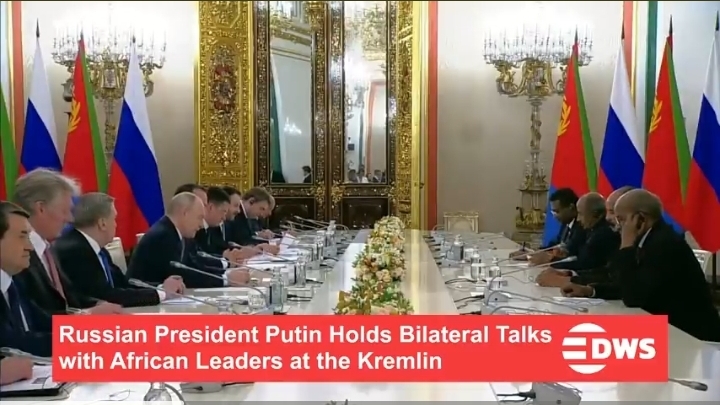
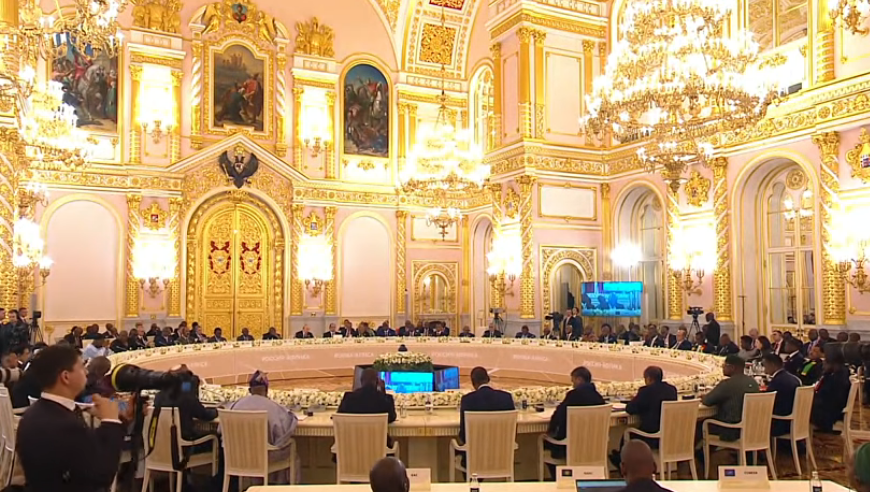
MOSCOW — Russia wants to deepen its economic relationship with Africa, while Ethiopia is looking to turn its longstanding ties with Moscow into practical cooperation in agriculture, energy and technology. Those priorities emerged in speeches by Russian President Vladimir Putin and Ethiopian Prime Minister Abiy Ahmed at the Third Russia–Africa Summit in Moscow.
Although the two leaders approached the partnership from different perspectives, their messages shared a common theme: political friendship matters, but its real value lies in what it delivers.
Putin focused on expanding trade, attracting investment and strengthening cooperation in areas ranging from agriculture to security. Abiy, meanwhile, stressed the need to build Africa’s capacity to produce food, generate energy, develop technology and create industries that can serve its growing population.

Putin said trade between Russia and African countries had exceeded $27 billion in the previous year, marking an increase since the previous summit in 2023. He described the growth as encouraging but argued that the two sides could achieve much more.
For Abiy, the challenge is not simply to increase trade. It is to ensure that economic partnerships help countries such as Ethiopia build stronger domestic industries and become less dependent on imported finished goods.
Turning economic ties into real opportunities
Putin identified energy, mining, fertiliser production, transport and tourism as areas where Russian businesses could expand their activities in Africa. He also pointed to opportunities in peaceful nuclear energy projects and urged companies to take a longer-term approach to investment.
In his view, businesses should contribute to the communities in which they operate by creating jobs, sharing technology, working with local companies and taking their social and environmental responsibilities seriously.
He also highlighted the growing use of national currencies in trade between Russia and African countries. According to Putin, the Russian rouble accounted for 85 per cent of payments between the two sides. He argued that such arrangements could make transactions less vulnerable to external financial pressures.
Abiy’s remarks offered a closer look at how this broader economic relationship might benefit Ethiopia. He said Russian companies could establish joint ventures in Ethiopian special economic zones, particularly in pharmaceuticals and machinery, producing goods that could eventually reach markets across Africa.
He also called for payment arrangements that would make trade between the countries easier and less costly.
The opportunity is clear, but the outcome will depend on what happens after the summit. Investment announcements alone will not transform economies. What matters is whether projects move forward, create employment, transfer skills and help local businesses grow.
Food security begins at home
Agriculture was one of the main subjects of Putin’s address. He said Russia supplied more than 15 million tonnes of grain to African countries in 2025 and a further 13 million tonnes in the first nine months of 2026. He also reported an increase in fertiliser shipments to the continent.
Putin said Russia contributes $10 million annually to the United Nations World Food Programme to support agricultural projects in African countries and provides humanitarian assistance to countries facing difficulties.
He argued that Africa had the potential to become a major agricultural exporter if countries invested in modern farming methods, technology and more efficient production systems.
Abiy approached the issue from Ethiopia’s development priorities. He said the country was investing in three key areas: food, energy and knowledge. The immediate goal, he explained, was to feed the population while building an agricultural economy capable of supporting lasting prosperity.
Cooperation with Russia could help Ethiopia acquire agricultural machinery and develop industries that process more of what farmers produce, he said.
That distinction matters. Food imports can help meet immediate needs, but stronger agricultural production and local processing can create jobs, reduce waste and allow countries to retain more value from their harvests.
For Ethiopia and other African countries, the long-term challenge is to make food security less dependent on supplies from abroad and more firmly rooted in productive domestic economies.
Ethiopia looks to nuclear energy
Energy was another important part of Abiy’s speech. He said Ethiopia was moving towards developing its first nuclear power plant in cooperation with Russia, with the project expected to follow the safety standards of the International Atomic Energy Agency.
The proposed plant would help diversify a national energy mix that currently depends heavily on hydropower, Abiy said.
He also pointed to the wider uses of nuclear science, including applications in agriculture and medicine. Nuclear technology, he noted, could help reduce food losses and support cancer treatment.
But Abiy made clear that building a facility would not be enough. Ethiopia would also need to develop the local expertise required to operate and regulate it safely.
That point reflects a wider issue facing many African countries pursuing major infrastructure projects: the benefits extend beyond the construction itself only when local institutions and professionals have the knowledge to manage the technology over the long term.
Cooperation with Russia, in this sense, would need to involve not just equipment and infrastructure but also training, technical knowledge and institutional capacity.
Artificial intelligence and the future of African knowledge
Abiy also devoted part of his address to artificial intelligence, arguing that Africa should have a greater role in developing the technologies that will shape its future.
He warned that the way AI systems are designed can influence which languages are supported, whose experiences are represented and how data are used.
African researchers, he said, should be able to develop tools in their own languages, while African institutions should have a say in how their data are handled.
Abiy said Ethiopia was establishing an artificial intelligence university in Addis Ababa and invited Russian universities and research institutions to cooperate in teaching and research.
Putin also identified artificial intelligence as an area for closer Russia–Africa cooperation, saying the summit would conclude with a declaration on the subject.
For African countries, the issue goes beyond adopting new technology. It is also about developing the skills, research institutions and computing capacity needed to create solutions suited to local conditions.
If cooperation in this area is to make a lasting difference, it will need to support African researchers and institutions rather than leave them dependent on technologies developed elsewhere.
A relationship built over generations
Abiy grounded Ethiopia’s relationship with Russia in a history stretching back more than a century.
He recalled that after the Battle of Adwa in 1896, a Russian Red Cross mission travelled to Ethiopia to treat wounded people. The mission also translated a medical guide into Amharic, an effort Abiy described as a small act with a lasting meaning because it brought knowledge into the service of healing.
The story gave his speech a human dimension. Beyond trade figures and government agreements, relations between countries can also be built through the exchange of knowledge and the practical work of professionals serving people in need.
Education and healthcare remain important parts of Russia’s wider engagement with Africa. Putin said around 40,000 African students were studying at Russian universities and approximately 300,000 Africans had graduated from Russian institutions.
He also highlighted Russian support for healthcare through medicines, mobile laboratories and training programmes intended to help African countries respond to infectious diseases.
These connections have created opportunities for generations of students and professionals. The next challenge is to ensure that cooperation continues to meet the needs of African communities and strengthens local institutions.
Security and Africa’s place in global affairs
Putin also addressed security cooperation, saying Russia had military and military-technical cooperation agreements with 45 African countries. He said Moscow continued to train African military officers and law-enforcement personnel and supported African-led efforts to resolve conflicts on the continent.
He further highlighted the expansion of Russia’s diplomatic presence in Africa. According to his speech, eight Russian embassies had opened since the 2023 summit, bringing the total to 48.
Beyond bilateral ties, Putin called for African countries to have a stronger voice in international institutions, including the United Nations Security Council and global financial organisations.
His remarks reflected a central argument in the summit: Africa’s growing economic and political importance should be matched by greater influence over decisions that affect the continent.
Abiy’s emphasis on sovereignty and national capability complemented that argument. Political independence, he suggested, must be supported by the capacity to produce, innovate and make effective use of knowledge.
The real test comes after the summit
Putin and Abiy outlined different but overlapping ambitions for Russia–Africa cooperation. Putin emphasised expanding trade, investment and diplomatic engagement, while Abiy focused on the practical capabilities Ethiopia hopes to develop in food production, energy and technology.
Their speeches presented a broad vision for closer relations. But the success of that vision will not be determined by the number of leaders attending the summit or the promises made from the podium.
For African countries, the important questions are whether investments create jobs, whether technology partnerships build local expertise, and whether trade helps domestic industries become more competitive.
For Ethiopia, the priorities outlined by Abiy suggest that cooperation will be judged by its contribution to food security, reliable energy, scientific research and industrial development.
For Russia, turning diplomatic goodwill into a durable partnership will require sustained investment and projects that respond to the needs of individual African countries.
The message from Moscow was that both sides want to move their relationship forward. The harder work begins when the speeches end and the commitments have to be delivered.