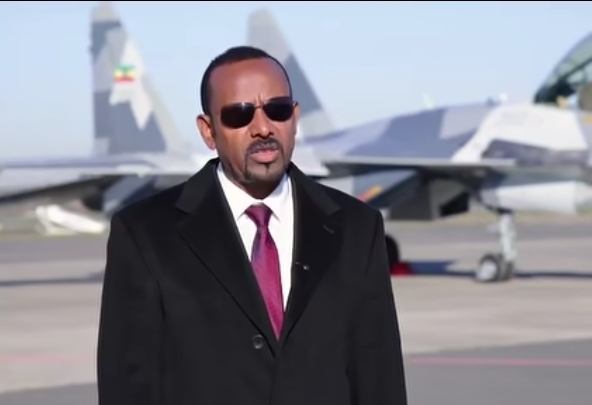
The sight of advanced fighter jets and air defence systems arriving from Russia would mean more to Ethiopia than a new addition to its military arsenal. For a country that has spent much of its history defending its independence and navigating difficult relations with its neighbours, such developments touch on a deeper question: how can Ethiopia protect its sovereignty in an increasingly uncertain region?
The reported acquisition of Su-35 fighter jets and plans to obtain S-400 air defence systems have placed this question at the centre of discussions about the Ethiopian military future. For the government, strengthening air power is part of preparing for threats that may emerge in a region where political rivalries, border disputes and shifting alliances continue to shape security calculations. For ordinary Ethiopians, however, the issue is more personal. It is about whether their country can remain safe, preserve its independence and avoid another devastating conflict.
Ethiopian history helps explain why military strength carries such emotional weight. The victory at Adwa in 1896 remains a powerful symbol of the country’s determination to defend its sovereignty. That legacy continues to influence how many Ethiopians view national security today. The circumstances have changed, but the desire to protect the country from external threats remains deeply rooted in the national consciousness.

Against this background, the prospect of acquiring more sophisticated military equipment can generate a sense of pride and reassurance. Modern fighter aircraft and long-range air defence systems can strengthen a country’s ability to monitor its airspace, respond to potential threats and discourage military pressure from abroad. For Ethiopian leaders, investing in these capabilities may be a way of ensuring that the country has more options if regional tensions escalate.
Yet the importance of such acquisitions goes beyond the equipment itself. Military power also carries a psychological dimension. When a country believes it can defend its airspace, its leaders may feel better positioned to negotiate with neighbouring states and respond to external pressure. A credible defence capability can also encourage potential adversaries to consider the risks before taking military action.
For a farmer in the Ethiopian highlands, a trader in a regional town or a family living in Addis Ababa, these strategic calculations may seem distant. Their immediate concerns are more familiar: the price of food, the availability of work, the safety of their communities and the hope that their children will grow up in peace.
Still, national security is not entirely separate from everyday life. A serious military confrontation could disrupt trade, displace communities, damage infrastructure and place additional pressure on an already demanding economic situation. In that sense, the argument for a stronger defence is not difficult to understand. People want to live in a country that can protect them from threats and give them a reasonable expectation of stability.
The Su-35, a Russian multirole fighter, is designed to perform a range of missions, including air combat and strikes against ground targets. The S-400, meanwhile, is a sophisticated air defence system intended to detect and engage certain aerial threats at long distances. Together, such systems could provide a country with additional military capabilities, provided they are properly integrated, maintained and operated by trained personnel.
But acquiring advanced weapons does not automatically translate into military superiority. Their effectiveness depends on much more than the hardware. Pilots require extensive training, maintenance crews need specialised skills, and sophisticated radar and missile systems must operate within a coordinated command structure. Spare parts, ammunition, logistics and long-term technical support are equally important.
There is also the question of cost. Modern military equipment is expensive to purchase and maintain, and its financial implications can extend well beyond the initial contract. For Ethiopia, where millions of people continue to face economic hardship and where public resources are needed for education, healthcare, infrastructure and employment, defence spending inevitably raises difficult questions about national priorities.
Consider a family struggling to cover the cost of food and school supplies. The arrival of advanced fighter aircraft might inspire pride in the country's growing military capabilities, but it does not immediately make life easier for that household. Parents still need jobs, children need classrooms, and communities need reliable access to basic services.
This does not mean that defence spending is unnecessary. A country cannot pursue development effectively if its security is constantly threatened. The challenge is to establish a balance in which military preparedness protects the conditions needed for economic progress rather than placing an unsustainable burden on them.
Ethiopia must also consider the wider regional consequences of expanding its military capabilities. The Horn of Africa is already shaped by complex relationships involving Ethiopia, Eritrea, Somalia, Djibouti and other regional and international actors. Relations between neighbouring countries can be influenced by disputes over territory, access to the sea, political influence and competing security interests.
In such an environment, stronger air power could improve the government's ability to deter external threats. However, the same developments could also generate concern among neighbouring countries, particularly if they are interpreted as preparation for confrontation rather than a defensive measure. One country's effort to feel more secure can sometimes make another country feel less secure.
This is one of the central dilemmas of military modernisation. Weapons intended to prevent war can contribute to an atmosphere of competition if neighbouring states respond by expanding their own arsenals. Without communication and confidence-building measures, the pursuit of security can become a cycle in which each side feels compelled to do more.
For Ethiopia, therefore, the challenge is not simply to acquire advanced equipment. It is to demonstrate that a stronger military can coexist with a serious commitment to regional peace. Diplomatic engagement, respect for international law and practical cooperation with neighbouring countries remain essential. Military strength can support diplomacy, but it cannot replace it.
The relationship with Russia also deserves careful consideration. Defence cooperation can provide Ethiopia with access to military technology and technical expertise, while giving Moscow an opportunity to maintain its influence in Africa. However, such partnerships require careful management. Ethiopia must consider the long-term costs, the availability of spare parts, the reliability of supply chains and the implications of international sanctions and geopolitical tensions.
Diversifying partnerships and ensuring that military procurement serves clearly defined national interests would help Ethiopia avoid excessive dependence on any single external supplier. Ultimately, the value of a defence partnership should be measured not by the prestige of the weapons involved but by their practical contribution to the country's security and long-term stability.
There is another important consideration: the distinction between military strength and national strength. A country may possess advanced aircraft and sophisticated missile systems while still facing serious internal challenges. Lasting security depends not only on protecting borders and airspace but also on building public trust, resolving political disputes and addressing the grievances that can fuel instability.
For Ethiopia, this distinction is particularly significant. Internal tensions and armed conflicts have imposed heavy human and economic costs on communities across the country. Military equipment designed to counter external threats cannot, by itself, resolve political disagreements or rebuild relationships damaged by violence.
A durable peace requires institutions that people trust, political processes that allow grievances to be addressed and economic opportunities that give communities a stake in stability. Without these foundations, even a well-equipped military may struggle to deliver the security that citizens expect.
The debate over Ethiopia's air power should therefore be understood in broader terms. It is not merely a question of how many fighter jets the country can acquire or how far its air defence systems can reach. It is a question of what kind of security Ethiopia wants to build and how that security will improve the lives of its people.
For many Ethiopians, the ideal outcome is straightforward. They want a country that cannot easily be intimidated by external pressure, but they also want a country where families do not have to live in fear of war. They want their government to be prepared for danger without becoming consumed by the expectation of conflict.
That is the balance Ethiopia must seek as it considers the future of its military capabilities. Advanced fighter jets and air defence systems may strengthen the country's ability to protect its sovereignty, but their ultimate significance will depend on how wisely they are acquired, maintained and used.
The real measure of success will not be the spectacle of military hardware or the declarations made during diplomatic visits. It will be whether Ethiopia becomes more secure without sacrificing its development ambitions, whether stronger defences help prevent conflict rather than intensify regional competition, and whether ordinary citizens can look towards the future with greater confidence.
In the end, a shield is most valuable when it protects people from the destruction of war. For Ethiopia, strengthening that shield may be a legitimate national priority. But the country’s lasting security will depend just as much on diplomacy, economic opportunity and domestic peace as it does on the aircraft and missile systems guarding its skies.