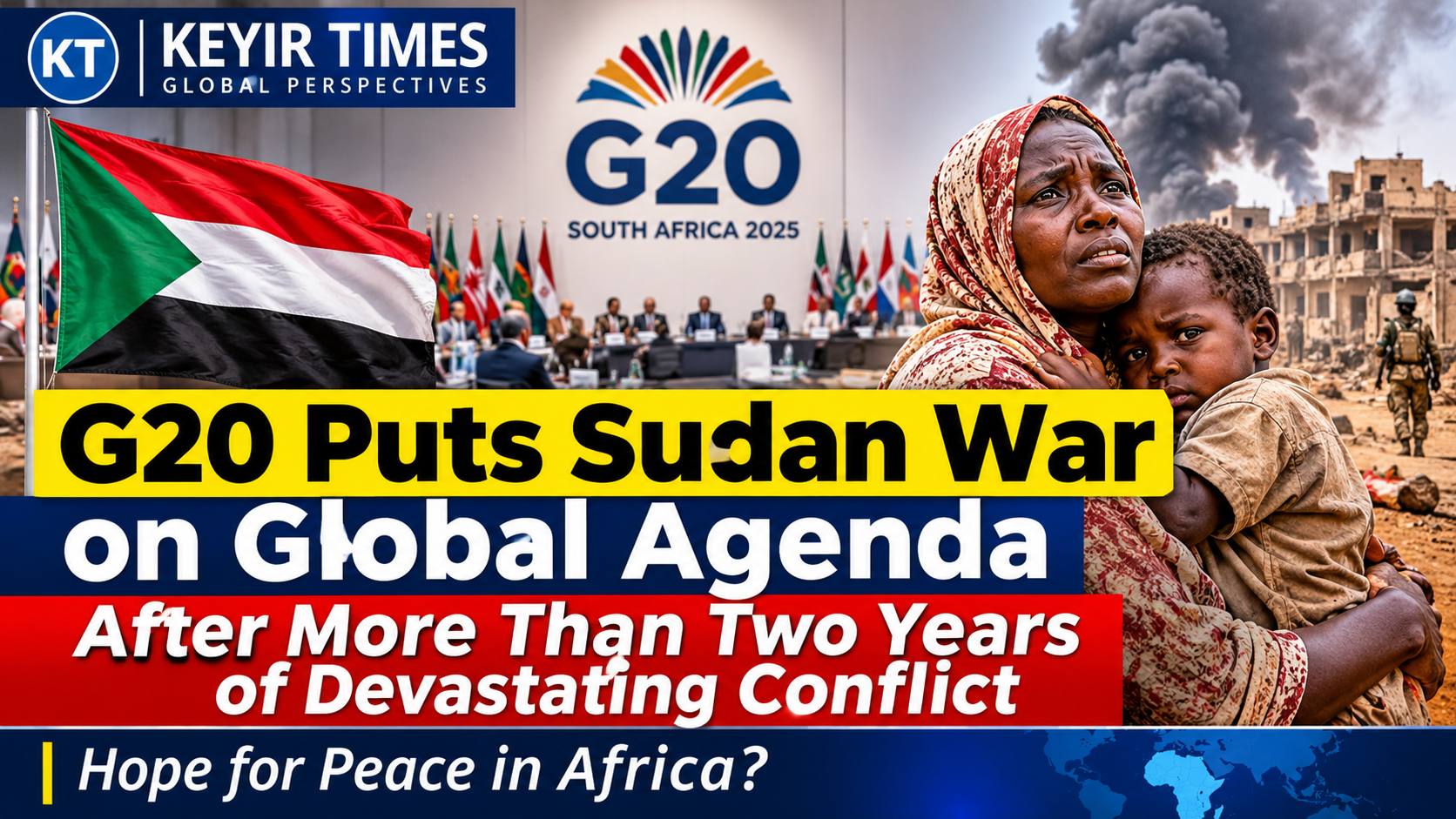
For more than two years, Sudan's devastating war has unfolded largely outside the centre of global political attention. Now, for the first time, the conflict has been brought into the spotlight at the G20, a development that Sudanese observers say could mark an important shift in how the international community responds to one of Africa's worst humanitarian crises.
G20 delegates reached consensus on working towards a “just, comprehensive and lasting peace” in several conflict zones, including Ukraine, Sudan, the Democratic Republic of Congo and the Occupied Palestinian Territory.
The inclusion of Sudan in the discussions is significant for a country whose conflict has displaced millions, destroyed vital infrastructure and pushed communities into deepening humanitarian suffering.

Sudanese commentator and journalist Saeed Abdalla described the move as an important moment after years in which the crisis struggled to maintain sustained international attention.
“I think for the first time, at the G20, now they bring the Sudan conflict to the forefront after more than two years,” Abdalla told local broadcaster Newzroom Afrika.
For many Sudanese, the recognition is long overdue.
Since fighting erupted, the country has been plunged into a devastating crisis that has affected virtually every aspect of life. Millions have been forced from their homes, hospitals and public services have been severely disrupted, and humanitarian agencies have faced enormous challenges reaching civilians trapped in areas affected by violence.
Despite the scale of the crisis, Sudan has often competed for international attention at a time when other wars and geopolitical tensions dominate global headlines.
The G20's decision to explicitly include Sudan in its discussions on peace could help change that.
While the statement does not provide a detailed peace plan or an immediate solution to the conflict, placing Sudan alongside other major global crises sends an important political message. It acknowledges that the war is not simply an internal African crisis but one that requires serious and sustained international engagement.
For Africa, the consequences of Sudan's instability also extend far beyond its borders.
The conflict has placed pressure on neighbouring countries as people flee violence and seek safety across borders. It has also raised concerns about wider instability in a region already facing multiple security and humanitarian challenges.
A prolonged conflict in Sudan could have serious consequences for the Horn of Africa and beyond.
This is why many analysts believe the international community must now move beyond statements of concern.
Diplomatic recognition is important, but it will mean little unless it is followed by stronger efforts to protect civilians, improve humanitarian access and support a credible political process aimed at ending the war.
The call for a “just, comprehensive and lasting peace” will also need to address the deeper consequences of the conflict. Sudan will require more than a ceasefire. It will need a political settlement capable of restoring stability and rebuilding institutions that have been weakened or destroyed by years of violence.
For ordinary Sudanese civilians, peace remains the most urgent priority.
After more than two years of war, millions continue to live with displacement, hunger, insecurity and uncertainty. Families have been separated, livelihoods destroyed and entire communities left struggling to survive.
The G20's recognition of the crisis offers a rare opportunity to place Sudan back at the centre of international diplomacy.
But the real test will be whether the world's leading economies and political powers are prepared to translate their words into action.
For Sudanese observers such as Abdalla, simply bringing the conflict “to the forefront” is already an important step. After years of limited global focus, Sudan is finally being recognised at one of the world's most influential political forums.
Yet for the millions whose lives have been shattered by the conflict, international recognition alone will not be enough.
What matters now is whether this renewed attention can help create meaningful pressure for peace and bring Sudan closer to an end to a war that has already cost the country—and Africa—far too much.