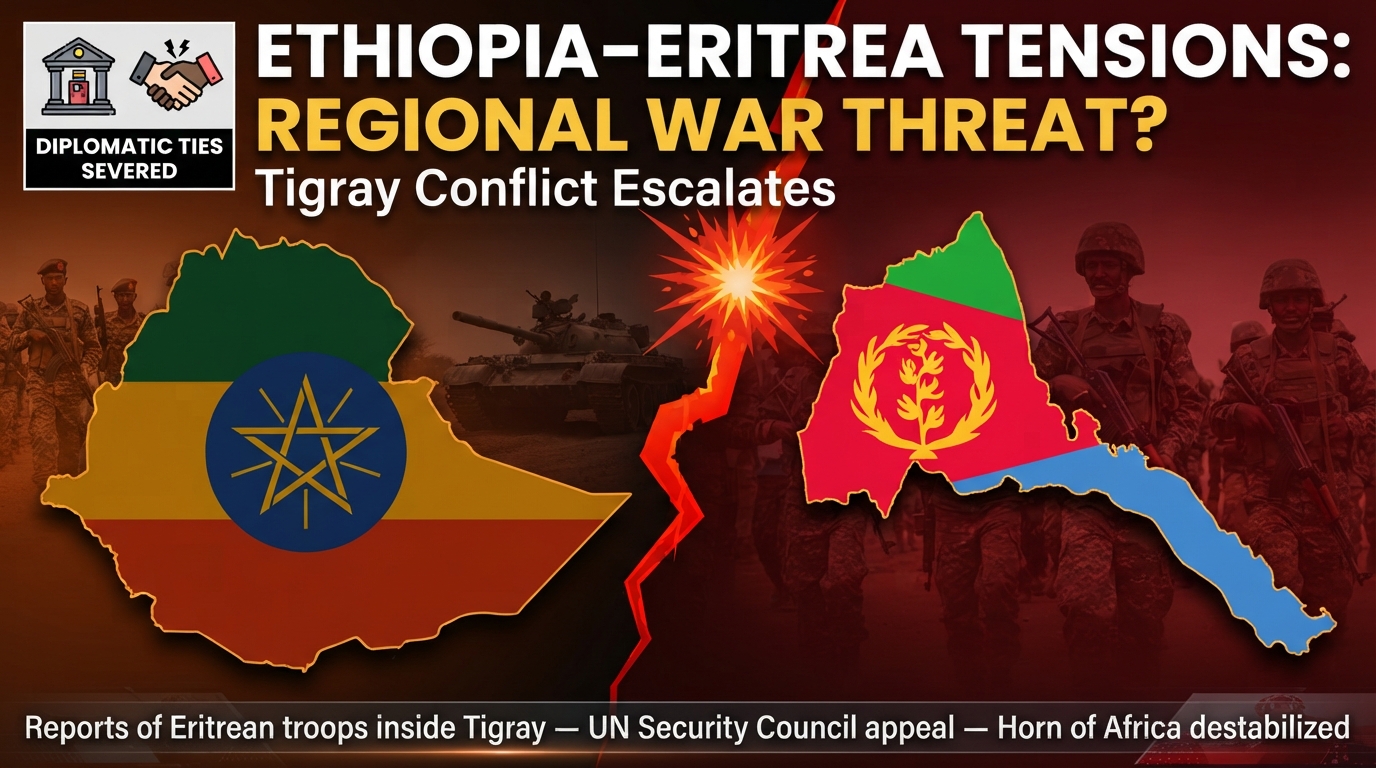
The renewed fighting in northern Ethiopia is evolving beyond a domestic conflict, raising the prospect of a direct confrontation between Ethiopia and Eritrea and threatening to destabilise the wider Horn of Africa.
Reports of Eritrean troops operating inside Tigray, the expulsion of diplomats, the closure of Ethiopia’s embassy in Asmara and Addis Ababa’s appeal to the United Nations Security Council point to a dangerous breakdown in relations between the two neighbouring countries.
The central question is no longer simply who controls territory in Tigray, but whether the conflict can be contained before it develops into another interstate war.

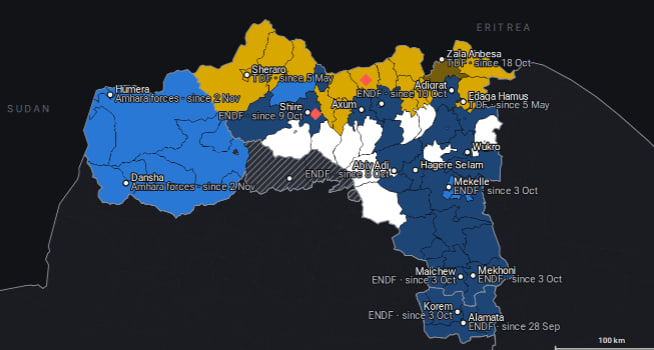
The latest fighting reportedly began after Tigrayan forces announced that they had taken control of three airports in the region, followed by clashes along the boundaries between Tigray, Amhara and Afar. Federal forces and their allies subsequently expanded their territorial control, while Tigrayan forces withdrew from several positions, including Mekelle, according to reports cited in the supplied account.
The conflict’s rapid escalation has created conditions in which local military developments, longstanding political grievances and competing regional security interests are increasingly interconnected.
The most consequential development is the reported entry of Eritrean forces into Ethiopian territory. Residents interviewed by international news organisations described seeing Eritrean soldiers, military vehicles and heavy weapons moving through Adigrat towards other parts of Tigray.
Ethiopian officials have also accused Eritrea of crossing the border and intervening militarily. Addis Ababa’s letter to the Security Council reportedly stated that Eritrean mechanised units had advanced between 30 and 60 kilometres into Ethiopian territory in three areas of Tigray.
Eritrea’s alleged involvement, however, must be distinguished from independently established facts about the conflict’s overall military picture. The Ethiopian government has made direct accusations, while Eritrea has rejected allegations of destabilising Ethiopia and has accused Addis Ababa of pursuing hostile objectives against its territory and coastline.
Reports from residents, international news organisations and conflict-monitoring bodies provide additional evidence to assess, but the full scale, objectives and command structure of Eritrean military involvement remain questions requiring independent verification. These distinctions matter because competing narratives are already becoming instruments of diplomatic and military mobilisation.
If Eritrean troops are operating inside Ethiopia as alleged, the implications extend well beyond the immediate battlefield. A foreign military presence on another country's territory raises questions of sovereignty, territorial integrity and the right to self-defence under international law.
Ethiopia’s appeal to the Security Council appears designed to establish an international record of its allegations, increase diplomatic pressure on Asmara and demonstrate that Addis Ababa considers the situation a national security emergency.
The appeal also serves a strategic purpose. By framing Eritrea’s actions as external aggression, Ethiopia is seeking to distinguish its military operations from the broader internal conflict in Tigray. That argument could strengthen its diplomatic position if the reported incursions are substantiated.
However, international support will depend not only on the seriousness of Ethiopia’s accusations but also on credible evidence, proportionality in any response and a willingness to pursue diplomatic de-escalation.
The collapse of diplomatic relations has made this crisis more difficult to manage. Ethiopia ordered 10 Eritrean diplomats to leave and announced plans to close its embassy in Asmara.
Eritrea subsequently declared a complete severance of diplomatic relations, while Egypt reportedly expelled an Ethiopian diplomat in a separate retaliatory measure. These developments narrow the channels through which the governments might communicate, clarify military movements or negotiate arrangements to prevent accidental escalation.
Diplomatic expulsions are not merely symbolic gestures. Embassies provide essential channels for communication during periods of hostility, including when governments have little political trust in one another. Their closure increases the importance of third-party mediation and informal communication.
It also raises the risk that military incidents, unverified reports or misunderstood intentions could trigger decisions that neither government initially intended to make.
The current breakdown is particularly significant given the history of Ethiopia–Eritrea relations. The two countries fought a devastating border war between 1998 and 2000 before Prime Minister Abiy Ahmed’s rise to power created an opportunity for rapprochement.
Ethiopia reopened its embassy in Asmara in 2018, and the two governments subsequently cooperated during the war in Tigray against Tigrayan forces. That partnership, however, rested largely on shared security objectives rather than a durable settlement of the countries’ competing strategic interests.
The rapprochement has since deteriorated, particularly amid Ethiopia’s increasingly explicit pursuit of access to the sea. Eritrea has interpreted Ethiopian statements about maritime access and its coastline as a potential threat to its sovereignty.
Ethiopia, meanwhile, has presented access to the sea as a strategic and economic priority. The dispute illustrates how an issue that Addis Ababa regards as central to its long-term national interests can be perceived by Asmara as a direct security challenge.
Neither country’s strategic concerns automatically justify military action against the other. Maritime access can be pursued through negotiated commercial arrangements, port agreements and regional economic cooperation.
Any attempt to obtain access through coercion or territorial aggression, by contrast, would deepen insecurity and reinforce the perception that diplomacy cannot protect national interests. The challenge is to separate legitimate economic ambitions from the use of force or threats that could destabilise the region.
The possibility of a broader war is also shaped by the military situation inside Tigray. Reports of drone strikes against Eritrean forces near Adigrat and the withdrawal of troops from positions around the town suggest that the battlefield may be changing rapidly.
If Ethiopian forces and their allies continue advancing, encounters with Eritrean units could become more frequent. Even a localised clash could provoke retaliation across the international border, transforming an already complex conflict into a direct confrontation between national armies.
Such an outcome would carry substantial humanitarian consequences. Tigray remains particularly vulnerable to renewed displacement, disrupted services and further damage to livelihoods after years of conflict.
Fighting involving additional national forces could impede humanitarian access, expose civilians to drone strikes and artillery, and undermine prospects for recovery. Border communities in Afar and Eritrea could also face insecurity, while the movement of people and goods across the region could be disrupted.
The reported explosions in Addis Ababa and the United States Embassy’s warning about potential long-range attacks against military facilities further illustrate the uncertainty surrounding the security environment.
The embassy’s travel advisory for Tigray, Amhara and Afar indicates heightened concern, but warnings alone do not establish who might carry out attacks or whether a specific operation is imminent. The absence of clear public explanations for some reported incidents creates an information vacuum in which speculation can intensify public anxiety.
The international response will be critical. The African Union, the United Nations and influential external partners have strong reasons to prevent another interstate war in the Horn of Africa. Yet diplomatic statements will have limited impact unless accompanied by sustained engagement, credible monitoring and pressure on the parties to avoid further escalation.
A practical first step would be to establish reliable communication channels, clarify the position of military forces near the border and seek arrangements to prevent further cross-border movements.
Ultimately, the crisis reflects the failure to transform a temporary strategic partnership into a stable regional relationship. Ethiopia and Eritrea face legitimate security concerns, but neither can achieve lasting security by treating the other’s vulnerability as an opportunity.
The immediate priority is to prevent further clashes, protect civilians and preserve space for negotiations. Without urgent de-escalation, the renewed Tigray conflict could become the trigger for a much wider war—one whose consequences would extend far beyond the two countries and threaten the fragile stability of the entire Horn of Africa.