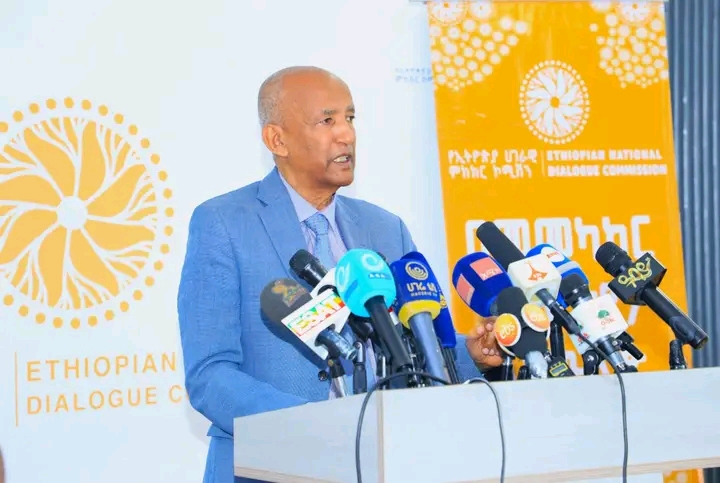
The Ethiopian National Dialogue Commission (ENDC) is set to launch its highly anticipated national plenary phase, convening 4,000 delegates in a high-stakes effort to reconcile deep-seated constitutional, administrative, and structural fractures. The process, which follows extensive consultations across 1,232 districts (woredas), marks a pivotal moment in the country's complex state-building trajectory.
In an exclusive interview with the state-run Ethiopian Broadcasting Corporation (EBC),Chief Commissioner Professor Mesfin Araya revealed that the upcoming assembly will consolidate feedback from a wide spectrum of society into eight thematic pillars. These include nation-building, constitutional review, identity and administrative boundaries, land tenure, and equitable development.
To manage the massive scale of the assembly, the 4,000 participants will be partitioned into eight distinct plenary groups of 500.

"Nation-building is not something you simply slice up like a cake; it requires structural anchors," Professor Mesfin stated. "We have established a framework to transition participants from a 'divergent zone' of initial polarization into rational, consensus-driven debates."
A cornerstone of the Commission’s methodology is its deliberate focus on peripheral and grassroots inclusion over exclusive reliance on the political elite. Professor Mesfin defended the decision to prioritize local pastoralists and agrarian communities, arguing that elite-driven narratives have historically exacerbated national polarization.
He cited a critical example from his field consultations in Jinka, where an elderly pastoralist woman accurately identified elite political maneuvering as the primary driver of national instability while expressing profound empathy for war-affected mothers in northern Ethiopia.
The Commission is also filtering grassroots grievances to differentiate between deep-seated constitutional disputes and everyday administrative failures. Issues such as localized border adjustments, corruption, and agricultural input shortages will be redirected to the appropriate regional and federal bodies.
"Access to fertilizer, for instance, is not a simple administrative task; it is a socio-political flashpoint," the Chief Commissioner explained, noting that persistent systemic failures in agricultural supply chains routinely drive vulnerable farmers into armed rebellion.
Addressing the ongoing security challenges, the ENDC reiterated its open-door policy for active armed groups, offering them a platform at the negotiating table without requiring immediate disarmament. Professor Mesfin cited Colombia’s 2016 peace accord with the FARC guerrilla movement as a successful historical precedent where prolonged conflict gave way to structured national dialogue and transitional justice frameworks.
While acknowledging that the political situation in the Tigray regional state required complex, back-and-forth diplomacy with the interim administration and the TPLF, the Commission confirmed that alternative channels have been successfully established to ensure the inclusion of Tigrayan perspectives and diaspora voices.
The plenary sessions are scheduled to run for at least 30 days, generating actionable policy and legislative recommendations. The Prime Minister’s office has officially pledged to implement the consensus-based outcomes, which the Commission hopes will ultimately pave the way for long-term transitional justice and institutional healing across the country.