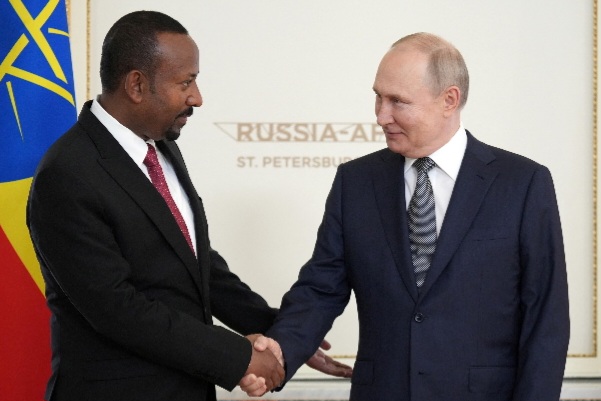
The relationship between Ethiopian Prime Minister Abiy Ahmed and Russian President Vladimir Putin reflects a pragmatic realignment grounded in geopolitical necessity, historical ties, and mutual resistance to Western diplomatic leverage.
Over recent years, this partnership has transformed from traditional diplomatic protocol into a strategic alliance that serves both leaders' broader international and domestic agendas.
For Abiy, Moscow offers an uncritical global partner with a permanent seat on the United Nations Security Council, providing vital diplomatic cover during internal conflicts and international scrutiny over human rights and regional security.

For Putin, Ethiopia represents a prestigious Gateway to East Africa and an influential diplomatic pivot point in Russia’s effort to expand its footprint across the Global South.
A central pillar of this evolving dynamic is the alignment of their strategic vision for a multipolar world order. Both leaders frequently critique Western dominance in global governance and financial institutions. Russia played an instrumental role in championing Ethiopia’s formal admission into the BRICS bloc, a milestone that significantly elevated Abiy’s domestic prestige and international standing.
This institutional integration has provided Addis Ababa with alternative avenues for trade, development finance, and diplomatic coalition-building, offsetting economic pressure and conditional aid strategies often employed by Western nations.
Beyond high-level diplomacy, the bilateral agenda is concrete, focused heavily on security, energy, and economic defense. Security cooperation remains a traditional backbone, encompassing military technology transfers, defense training, and intelligence sharing.
Concurrently, Russia’s state nuclear agency, Rosatom, has pursued preliminary agreements to develop civilian nuclear technology infrastructure in Ethiopia, positioning Moscow as a critical partner in the country’s long-term energy diversification plans.
Economically, both nations are actively seeking settlement mechanisms outside the U.S. dollar system to facilitate trade in agriculture, mining, and raw materials, shielding their commercial exchanges from Western sanctions and financial controls.
Ultimately, the Abiy-Putin relationship exemplifies modern transaction-based diplomacy. It allows Prime Minister Abiy to balance Ethiopia's foreign policy by maintaining leverage with Western capitals while deepening structural ties with Eastern powers.
For President Putin, maintaining a close, collaborative bond with Africa's second-most populous nation demonstrates that Russia remains far from isolated on the global stage, using soft power, security partnerships, and institutional backing to consolidate its position across the African continent.