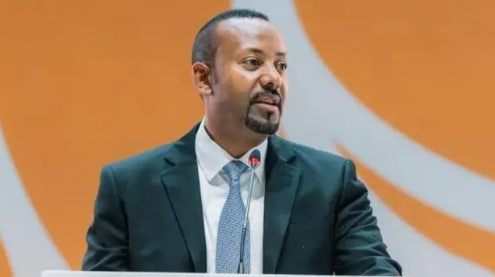
The launch of the National Dialogue Commission’s final conference in Addis Ababa marks a highly anticipated moment in Ethiopia’s modern political history. For more than four years, the Commission has gathered agendas and selected representatives across a deeply fractured nation. Now, as four thousand delegates gather at the Addis Convention Center, Prime Minister Abiy Ahmed has used the opening stage to signal a profound shift: the potential dismantling or heavy modification of the country’s thirty-year-old constitution.
Yet, while the sheer scale of the gathering is a logistical achievement, a critical question remains. Can a summit of four thousand people in a secure hall in the capital resolve conflicts that are actively raging in the fields, hills, and towns of Ethiopia? The Prime Minister’s address went far beyond a standard welcome; it laid out a bold, high-stakes vision for the country’s constitutional future and its place in the Horn of Africa. However, a close analysis of his remarks reveals a deep tension between the government’s lofty rhetoric of unity and the harsh realities of active war, political exclusion, and escalating regional hostility.
In his opening speech, Prime Minister Abiy drew a direct comparison between Ethiopia’s current dialogue and the drafting of the United States Constitution. He noted that the American constitution was drafted by just 55 men who created a document that has lasted for over two centuries. "Our four thousand people," Abiy argued, "are more numerous, have had more time, and can act with greater wisdom to draft a covenant that gathers all Ethiopians." He suggested that once this massive group agrees on a path forward, the resulting constitution will be so structurally sound that "not a single person" will be able to easily tear it down.

This comparison is politically clever, but it overlooks a fundamental truth about constitutional legitimacy: representation is not a game of numbers. A document does not become legitimate simply because four thousand people sign off on it; it becomes legitimate because the people who hold political, social, and military power across the country believe in it.
Today, Ethiopia’s national dialogue is taking place in a vacuum of complete inclusion. Major armed groups—such as the Fano militias in the Amhara region and the Oromo Liberation Army (OLA) in Oromia—are not sitting at the table. Significant opposition parties have either boycotted the process or feel systematically excluded. When the guns are still firing in Ethiopia's two most populous regions, a constitutional consensus reached in a guarded convention center in Addis Ababa risks being viewed as an elite pact rather than a genuine national covenant. If those who fight on the ground do not buy into the process, the new constitution will suffer from the same original sin as the 1995 document: it will be seen as a tool imposed by the ruling power of the day.
The current Ethiopian constitution, established in 1995, institutionalized multinational federalism, organizing the country along ethnic territories. For three decades, this system has been the ultimate fault line in Ethiopian politics. Critics argue it divided the nation and fueled ethnic violence, while proponents insist it is the only framework that protects the rights of Ethiopia’s diverse nationalities.
By hinting at a major rewrite, Abiy is signaling a desire to transition away from this ethnic federalist model toward a stronger, more centralized state. His assertion that "we have consulted for four years; [a future system] cannot change it without consulting for eight years" shows an intent to lock in these upcoming changes.
However, rewriting a nation's foundational contract during a time of intense polarization is incredibly risky. If the government uses the National Dialogue to push through a pre-determined centralized agenda under the guise of "popular consensus," it could trigger even greater instability. For many regional federalists, any attempt to dismantle ethnic federalism without their active consent is viewed as an existential threat. Rather than healing the country's divisions, a forced constitutional overhaul could solidify them.
Perhaps the most volatile element of the Prime Minister’s address was his pivot to foreign policy and the Red Sea. Abiy lamented the historical loss of Ethiopia’s access to the sea, blaming an "unelected government" that "through deceit" made the country a "geographical prisoner." This is a direct attack on the former EPRDF regime and the historical handling of Eritrea’s secession.
Abiy warned of external enemies—whom he described as "vultures hovering in the sky"—waiting to exploit Ethiopia’s internal divisions. He stated bluntly that while these forces try to intervene when Ethiopians quarrel, "no vulture can take a single kilogram of meat" from Ethiopia's table.
While this fiery, nationalist language is designed to unite a fractured domestic audience against a common external enemy, it carries severe geopolitical risks. Relations between Addis Ababa and Asmara are already at an all-time low. Simultaneously, Egypt—locked in a bitter dispute with Ethiopia over the Grand Ethiopian Renaissance Dam (GERD)—has actively strengthened its military and diplomatic ties with Eritrea and Somalia. By reviving claims to the Red Sea and using aggressive metaphors on a national stage, the Prime Minister risks turning regional anxieties into a self-fulfilling prophecy. A country suffering from deep internal economic strain and multiple domestic insurgencies can ill afford to stoke regional proxy wars.
The Prime Minister rightly observed that Ethiopian politics has historically "begun with forceful words and ended with forceful words," calling for an end to this destructive cycle through the traditional values of arbitration, forgiveness, and compensation.
Yet, the primary test of this dialogue is not the elegance of its speeches, nor is it the impressive diversity of the four thousand delegates gathered in the capital. The true test of the National Dialogue Commission is whether its outcomes can silence the guns.
For the dialogue to be a genuine success, the Ethiopian government must align its peaceful rhetoric with concrete actions:
Establish Genuine Ceasefires:- Talk of national reconciliation is hollow while active military campaigns and drone strikes continue to devastate civilian areas in Amhara and Oromia.
Engage the Outliers:- The government must find a way to bring armed actors and dissident political groups into the conversation, even if it requires difficult compromises.
Ensure Process over Pre-determination:- The constitutional reform process must not be used to fast-track a pre-approved centralized state structure; it must reflect a compromise that addresses both regional autonomy and national unity.
The National Dialogue represents a rare, fragile opportunity for Ethiopia to rewrite its troubled political script. But as the delegates begin their discussions, they must remember that true peace is not a paper exercise. If the resolutions passed in Addis Ababa do not translate into safety, justice, and stability for the farmer in Gojjam, the merchant in Wollega, or the displaced family in Tigray, then the gathering of four thousand people will have been a costly distraction. The success of this historic moment will not be measured by the number of people who filled the convention center, but by whether they succeeded in bringing all parties to the peace table and finally silencing the guns on the ground.