In a democratic system, parliament is the ultimate sanctuary of the people, a place where the public voice is heard, government operations are scrutinized, and transparency reigns supreme.
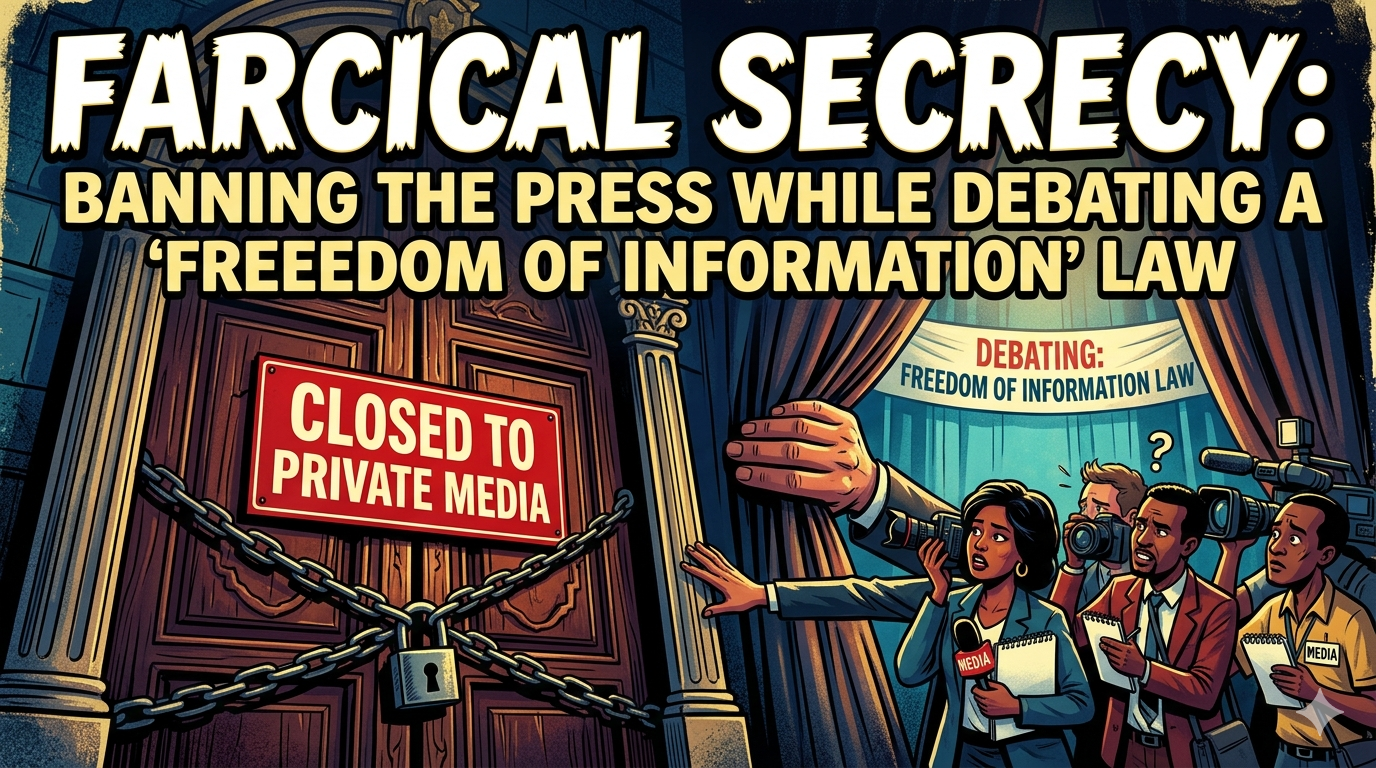
However, the recent trajectory within the House of Peoples' Representatives of the FDRE has taken a diametrically opposite turn. By shutting its doors to private media during regular and standing committee meetings, the House is officially suffocating the public's right to access information.
Watching the very institutions that claim to uphold the rule of law violate their own statutes and turn journalists away at the door is a chilling indicator of the political direction this country is heading.

As explicitly stated in Article 58 (5) of the FDRE Constitution and Regulation No. 6/2006 on the Working and Members' Code of Conduct of the House, all parliamentary meetings must be conducted openly.
A session can only be closed to the public if requested by the executive branch or by members of parliament, and if that request is backed by a majority vote of the house.
Yet, what we are witnessing today defies this legal framework. Parliament has offered no official explanation nor has it held a formal vote to justify banning private media.
This reveals that the institution is no longer governed by law and established procedures, but rather by the whims and "orders" of a few individuals. Handpicking state media while locking out the private press is not just blatant discrimination, it is a deliberate attempt to bury independent journalism.
One cannot help but wonder, what secrets are being kept that require a shroud of secrecy over the parliamentary doors? The closed-door sessions evaluated the nine-month performance reports of the Ministry of Finance, the Ministry of Health, the Ministry of Water and Energy, and the Development Bank.
Given that these institutions manage public funds and interests, their performance should be fully transparent to the public.
The ultimate contradiction, however, lies in the fact that the "Freedom of Information Draft Proclamation" itself was discussed behind closed doors by the Standing Committee on Democratic Affairs. Watching a draft law meant to grant access to information begin its life by denying that very access is both farcical and tragic.
This approach perfectly mirrors the warning of Dr. Abdisa Zerai, a journalism lecturer and researcher at Addis Ababa University:
"Saying 'you shall not come near this area except for those I have chosen' is an act that erodes the citizens' right to information."
Amid this crisis, the lethargy displayed by institutions designed to anchor democracy, such as the Ethiopian Human Rights Commission (EHRC) and the Ethiopian Institution of the Ombudsman, is another devastating blow to the media landscape.
According to the recent news report from Sheger Radio, the Ombudsman claiming, "We haven’t followed up because we haven’t received a formal written complaint," is a pathetic bureaucratic excuse, not a display of institutional responsibility.
The EHRC similarly folded its arms, stating, "We have not conducted an investigation, so we will not comment."
When a nationwide media ban is being enforced and journalists are actively being expelled from parliament gates, for these watchdog institutions to choose silence under the guise of "not receiving a written complaint" demonstrates just how numb the regulatory system has become.
As noted by Tamrat Hailu, Deputy Executive Director of the Ethiopian Media Council, the right to information is a fundamental human right granted not just to journalists, but "to all citizens." Barring the media means blinding the public so they cannot see what the representatives they voted for are actually doing on their behalf.
The government has a legal obligation to respect freedom of information. If parliament ceases to be a gathering place for the people's representatives and transforms into a "house of secrets" operating solely on the whim of a few officials, it might as well officially declare the death of the democratic system and close the curtains entirely.
If not, this unlawful ban must be lifted immediately, and the doors of parliament must be reopened to the independent press.