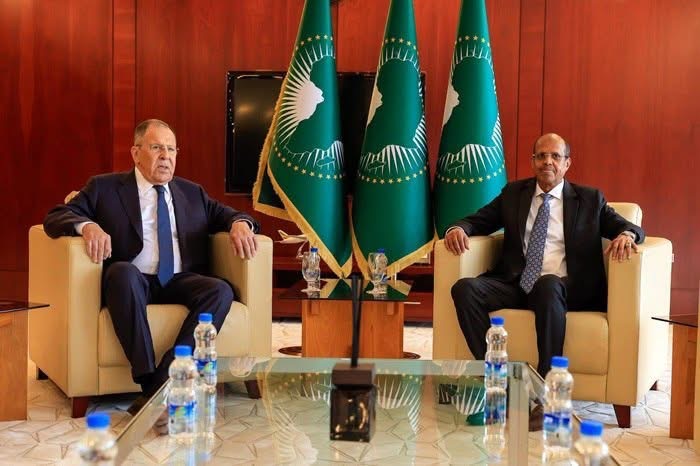
The geopolitical landscape of Africa is undergoing a profound re-alignment, and Moscow is positioning itself as a central pillar in this new architectural shift. This reality is brought into sharp focus by Russian Foreign Minister Sergey Lavrov's official working visit to Addis Ababa.
As the political capital of Africa and the seat of the African Union (AU), Addis Ababa serves as the perfect backdrop for Russia to project its influence, consolidate historical ties, and expand its footprint across the continent.
Lavrov's high-level engagements including extensive consultations with Ethiopian Prime Minister Abiy Ahmed, Foreign Minister Gedion Timothewos, and AU Commission Chairperson Mahmoud Ali Youssouf underscore a multi-layered diplomatic strategy. Rather than viewing Africa through a purely transactional lens, Moscow is cultivating deep strategic alignments structured around three core pillars: multilateral solidarity, security partnerships, and critical economic infrastructure.

A major driving force behind the contemporary Africa-Russia relationship is the shared desire to challenge Western-led unilateralism. Russia's foreign policy champions a "multipolar world order," a narrative that resonates deeply with African nations seeking greater autonomy in global governance.
Ethiopia's full membership in the expanded BRICS bloc provides a formal, institutionalized vehicle for this partnership. During his talks in Addis Ababa, Lavrov emphasized closer coordination within BRICS to push for the reform of global economic structures and the UN Security Council. By aligning with African aspirations for a more equitable global voice, Russia successfully positions itself not as a traditional donor, but as a sovereign equal and diplomatic shield against Western pressure.
Historically rooted in Moscow's support for African liberation movements during the mid-20th century, modern Africa-Russia relations are heavily anchored in security cooperation. Across the Sahel region and the Horn of Africa, nations are increasingly turning to Moscow for defense partnerships, military hardware, and intelligence cooperation.
Crucially, Russia's security doctrine appeals to African leadership because it operates on a strict principle of non-interference in domestic political affairs. While Western aid packages are frequently tied to democratic benchmarks or human rights conditionalities, Moscow offers security guarantees and technical assistance without lecturing sovereign governments.
In an era where several African states are pushing back against Western paternalism, Russia's transactional, state-centric approach offers an attractive alternative.
While defense has historically dominated Russia's engagement, Lavrov's visit highlights an ongoing shift toward economic diversification, particularly in high-tech and energy sectors. Discussions during the Addis Ababa tour notably touched upon trade expansion, technology transfer, and critically, exploration into nuclear energy infrastructure.
Faced with severe energy deficits that hinder industrialization, several African states view Russia's state-owned energy corporations, like Rosatom, as viable partners for developing civilian nuclear power plants. By shifting the conversation toward critical infrastructure and industrial development, Russia aims to move beyond a purely extractive economic model to become a foundational partner in Africa's modernization.
The Path Forward: The timing of Lavrov's tour is highly deliberate. It lays the diplomatic groundwork for the upcoming 3rd Russia–Africa Summit, scheduled for late October in Moscow, where a new three-year action plan (2027 - 2029) will be finalized.
Ultimately, Sergey Lavrov's presence in Addis Ababa demonstrates that Russia's pivot to Africa is a permanent fixture of its global strategy. For African nations, navigating this relationship is not about choosing Moscow over the West, but rather leveraging a multipolar world to maximize their own strategic autonomy, development, and national security.