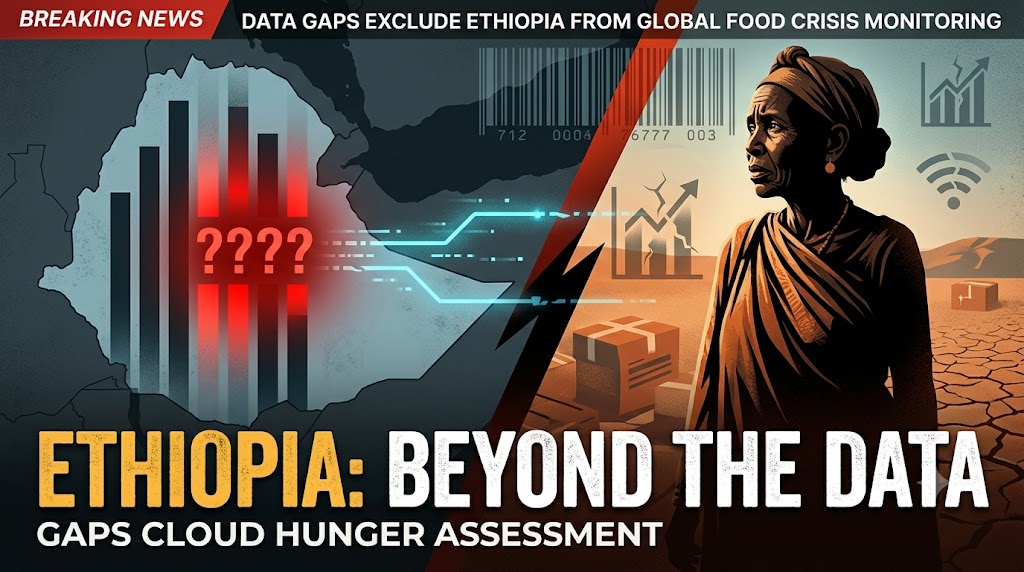
Severe data gaps have excluded Ethiopia from the latest Global Report on Food Crises (GRFC), following a failure to produce acute food insecurity metrics that met the publication’s rigorous technical standards. The omission has triggered significant concern among development economists, domestic policy analysts, and international humanitarian partners regarding the state's current capacity to accurately quantify the scale of structural hunger and effectively coordinate targeted aid interventions.
The 2026 report, co-authored by the Food and Agriculture Organization (FAO), the World Food Programme (WFP), and the Global Network Against Food Crises, identified Ethiopia as one of 18 vulnerable nations excluded due to a lack of comparable, methodologically sound data for the 2025 calendar year.
In the 2025 edition of the report, Ethiopia accounted for a staggering 27 million people facing high levels of acute food insecurity based on 2024 data. The sudden absolute absence of updated consensus figures for 2025 leaves a massive analytical blind spot in global humanitarian tracking.

Despite the lack of current statistical projections, the inter-agency network maintained Ethiopia on its flagship index of 65 high-priority nations highly susceptible to systemic food crises. Crucially, the authors of the report explicitly cautioned that the country's exclusion must not be interpreted as an empirical improvement in baseline food security conditions.
Instead, they warned that the widening information gap is becoming a severe humanitarian concern in its own right, reflecting a broader, systemic contraction in global food security monitoring. The document attributed these tracking failures to shrinking donor budgets for field assessments, logistical access constraints in remote agro-ecological zones, and bureaucratic frictions in securing official authorization to collect or share disaggregated household welfare metrics.
The information deficit arrives at a highly sensitive macroeconomic juncture for Ethiopia. The federal government is currently navigating deep, volatile structural adjustments under an IMF-supported program, including the ongoing managed float of the Birr and major fiscal consolidation measures. Just this week, the IMF Executive Board completed its fifth review of the Extended Credit Facility (ECF), unlocking an additional $464 million to ease near-term financing pressures.
However, local analysts note that the sweeping reforms have triggered severe domestic cost-of-living challenges. In tandem with the elimination of fuel subsidies, the Ministry of Trade and Regional Integration implemented three successive fuel price revisions between December 2025 and May 2026, driving diesel prices up by roughly 40 percent. These surging energy costs have dramatically inflated transport overheads for agricultural inputs and staple foods just as the lean season begins.
Independent assessments by agencies like FEWS NET indicate that while recent belg rains brought localized relief, areas in northern Amhara, Tigray, and the pastoralist south remain under severe strain, with conflict and high food prices locking thousands of households into Emergency (IPC Phase 4) conditions.
International donors rely heavily on the GRFC’s Integrated Food Security Phase Classification (IPC) metrics to determine funding prioritization. Without a standardized, internationally comparable baseline, aid agencies warn of structural inefficiencies and misallocated resources when addressing localized shocks.
As Ethiopia attempts to transition toward an open, private-sector-driven economy, independent economists argue that maintaining transparent, high-frequency data streams is imperative to preserve the confidence of multilateral donors and safeguard the integrity of the national safety net framework.