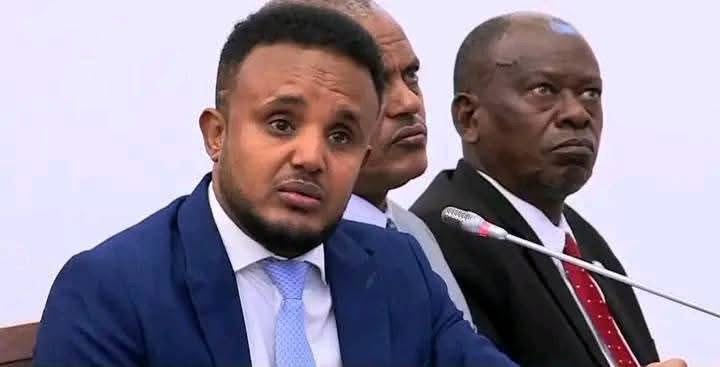
The atmosphere inside the House of Peoples' Representatives in Addis Ababa this week was far from the choreographed rubber-stamping that often characterizes state reviews. Instead, the chamber became a political fault line, witnessing a bruising collision between official triumphalism and the lived reality of a population pushed to its absolute limits.
The catalyst for this rare rupture was a fierce, systemic interrogation by opposition MP Dr. Dessalegn Chane. Directed squarely at the Prime Minister, Chane’s address bypassed routine political posturing to offer a structural autopsy of modern Ethiopia’s socio-economic fabric.
On paper, the government’s 2018 Ethiopian Calendar (EC) budget report reads like an economic miracle: a vaulted 10.2% macroeconomic growth rate, domestic tax revenues surging to 1.5 trillion Birr, and 7.7 billion dollars flowing from Foreign Direct Investment (FDI) and financial injections from international lenders. Yet, as Chane stepped to the podium, the mood in the gallery shifted. His critique exposed a profound paradox: how can a state boast historic macroeconomic success while its citizens plunge into unprecedented precarity?

The most devastating sociological insight from the debate was Chane's formal declaration of the death of the Ethiopian middle class. "In our country today, the middle class has vanished," Chane stated flatly. "We are left with a deeply polarized two-tier society: a minute, hyper-wealthy elite and a vast majority languishing in poverty."
In any developing economy, the middle class, salaried civil servants, private sector professionals, academics, and small-scale traders, serves as the bedrock of civic and financial stability. Today, that bedrock is crumbling under the weight of hyperinflation triggered by the government’s aggressive macroeconomic adjustments and foreign exchange liberalization.
With housing rents in urban centers now comfortably eclipsing the entire average monthly salary of fixed-income earners, thousands are experiencing what Chane termed "hidden hunger" (በስውር ረሀብ). Citizens can no longer afford to shelter and feed their families simultaneously. Chane's underlying message was clear: no amount of statistical manipulation can conceal the structural fractures of Medemer (Synergy), the state's signature governance narrative, when it fails to guarantee basic survival.
Chane’s scrutiny extended deep into the state’s financial architecture. He accused the Ministry of Finance and the Central Bank of semantic gymnastics regarding the country's debt profile. While state officials repeatedly declare that Ethiopia has not taken out new "commercial loans," Chane illuminated a massive domestic borrowing spree.
By aggressively issuing Treasury bills (T-bills) and internal debt instruments to borrow billions from local banks, the government has created a double penalty: concealing the true scale of sovereign debt while effectively crowding out the private sector. With commercial credit choked off, local small and medium enterprises (SMEs) are starving for capital. Furthermore, by glossing over incomplete restructuring negotiations with Eurobond holders, the state is hiding the fact that Ethiopia remains in technical debt distress (Debt Distress), floating on temporary foreign exchange lifelines rather than sustainable productivity.
The indictment turned even bleaker when addressing human capital. Chane, a former educator, termed the recent 92\% failure rate in the Grade 12 national leaving examinations an unmitigated "Generational Catastrophe" (ከፍተኛ የትውልድ ብክነት). Only 8.7% of students scored above the 50% threshold.
Invoking a fundamental pedagogical maxim, "If an entire class fails the test, it is the educator, not the student, who has failed", Chane laid the blame for this systemic collapse directly at the feet of the Ministry of Education. This academic bankruptcy is compounded by a darker geopolitical reality: 7 million children remain completely locked out of school due to ongoing civil conflicts and displacement, a demographic larger than the total population of several sovereign African states.
The debate also pulled back the curtain on the contentious politics of humanitarian aid in the Horn of Africa. The government’s recent claim that "data verification" successfully slashed the number of aid-dependent citizens from 27 million down to 2.3 million was met with sharp skepticism. Chane noted that this radical reduction directly contradicts independent assessments by global monitors like the World Food Programme (WFP) and the Food and Agriculture Organization (FAO), which estimate that between 15.8 and 21.4 million Ethiopians still face acute food insecurity.
Furthermore, the state’s mandate forcing international non-governmental organizations (NGOs) away from physical food distribution in favor of cash transfers (Cash Transfer) was criticized as reckless. In a hyper-inflationary market where currency value depreciates by the week, cash cannot keep pace with skyrocketing commodity prices, trapping millions in artificial food scarcity.
Chane concluded with a series of sharp policy prescriptions that challenge the administration’s current spending priorities to the following points.
The state must pivot its resources away from high-visibility urban beautification projects, such as corridor developments, luxury eco-lodges, and riverside parks, and invest heavily in foundational industries like metallurgy, domestic machinery engineering, pharmaceutical complexes, and fertilizer plants (DAP and Urea) to revive true domestic production.
The upcoming National Dialogue must be completely insulated from state interference. Rather than rushing a superficial process, it must inclusively bring all armed and unarmed political actors to the table to hammer out a genuine political settlement (Political Settlement).
Ethiopia must transition toward true fiscal federalism, rectifying regional resource inequities and moving away from top-down, centralized dictates that exacerbate ethnic polarization.
What transpired in parliament was a stark warning that Ethiopia cannot build stability on aesthetic infrastructure and transient foreign currency reserves while its social fabric, public education, and regional security disintegrate.
As the country navigates a volatile landscape, the fundamental question remains: will the administration pivot from military coercion in regional conflicts toward an inclusive political settlement, or will it continue to use macroeconomic abstractions to mask a deepening human crisis? For ordinary Ethiopians, the hope for the coming year is not found in the growth charts of the central bank, but in the tangible return of security, stable markets, and a sustainable peace.