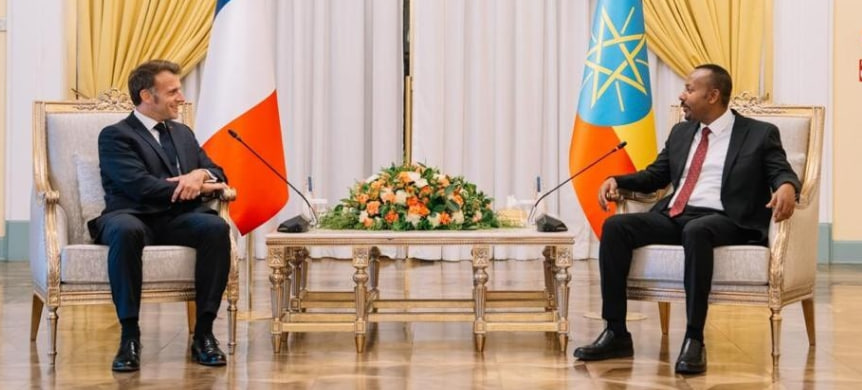
The National Palace was the backdrop for a high-stakes display of "checkbook diplomacy" this week as Prime Minister Abiy Ahmed (PhD) and French President Emmanuel Macron presided over the exchange of a multi-million-euro financial package. While the official communiqués framed the visit as a celebration of bilateral solidarity, the granular details of the agreements—spanning from renewable energy loans to Geothermal Public-Private Partnerships (PPP)—reveal a French administration eager to anchor its economic influence in the Horn of Africa’s energy transition.
The center-piece of the engagement was the signing of a 54.6-million-euro loan agreement dedicated to the "Renewable, Integrated, Sustainable Energy and Digitalization Program." Yet, for seasoned observers of Ethiopia’s debt-laden landscape, the infusion of more sovereign debt—even for "green" initiatives—raises salient questions about the long-term cost of French patronage.
Perhaps the most structurally significant development was the exchange of a new "Framework and Roadmap" for a 150MW Geothermal PPP engagement. For an administration that has made the transition from state-led infrastructure to private-sector participation the cornerstone of its Homegrown Economic Reform, the geothermal deal is a litmus test.

Geothermal energy, unlike hydro, requires massive upfront capital and sophisticated technical expertise—commodities that the French state and its corporate titans, such as Électricité de France (EDF), are keen to export. By moving toward a PPP model for a project of this magnitude, Addis Abeba is effectively outsourcing the geological and financial risks to international consortiums. However, the "roadmap" remains opaque on the most critical variable for the Ethiopian consumer: the power purchase agreements (PPA) and the eventual tariff rates that will be required to make such a 150MW venture profitable for French investors.
The inclusion of "Digitalization" in a 54.6-million-euro loan package underscores the broader strategic intent. As Ethiopia liberalizes its telecom sector and builds out its digital ID infrastructure, France is positioning its technology firms to be the architects of Ethiopia’s digital future.
Yet, this partnership is not a grant; it is a loan. As Ethiopia continues its grueling negotiations with the IMF and Paris Club creditors for debt restructuring, the optics of signing new multi-million-euro credit lines are complicated. Critics argue that while "sustainable energy" is a noble pursuit, the increasing reliance on bilateral loans from European capitals for core infrastructure creates a "policy lock-in," where future energy and digital strategies are tethered to the standards and vendors of the creditor nation.
For President Macron, the visit to Arat Kilo is a calculated move to maintain French relevance in a region increasingly contested by Middle Eastern and Asian powers. By focusing on "Renewable Energy" and "Sustainable Development," Paris is attempting to brand its engagement as "ethical investment," contrasting itself with the more transactional infrastructure deals of the past.
However, the "substantive bilateral discussions" mentioned by the Prime Minister likely delved into the murky waters of regional security and Ethiopia’s internal stability—factors that ultimately dictate the viability of any 54.6-million-euro investment.
The Abiy-Macron summit succeeded in producing the high-value optics required for international diplomacy. But for Ethiopia’s macroeconomists, the success of the 150MW geothermal roadmap will be measured not by the signing ceremony, but by the transparency of the PPP framework and whether the 54.6-million-euro loan generates enough economic productivity to service itself.
As France reinforces its position as a "preferred partner" for Ethiopia’s green transition, the Ethiopian public is left to wonder if these agreements represent a genuine transfer of technology or merely a sophisticated rebranding of bilateral indebtedness. In the high-stakes game of energy diplomacy, the heat of the geothermal fields is matched only by the pressure on Addis Abeba to balance its growing list of international creditors.