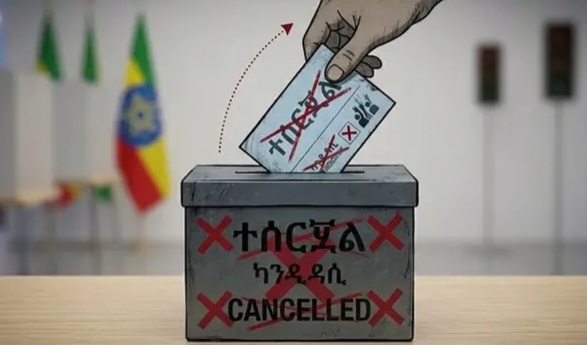
The Ethiopian National Electoral Commission’s (NEB) recent announcement confirming the completion of overseas ballot printing has brought a stark reality to light: out of the 48 political parties that initially registered and selected their electoral symbols, six have been disqualified.
This winnows the playing field down to 42 parties for the upcoming 7th General Election. Far from being mere bureaucratic casualties, the sidelining of these six parties highlights the deep-seated security, institutional, and legal fractures currently defining Ethiopia’s political landscape.
An analysis of these disqualifications reveals three distinct systemic bottlenecks. Half of the disqualified parties hail from the Tigray region: The Democratic Coalition of Tigray (Simret), Tinsa’e Seba’e Enderte, The Tinsa’e Sira’at Qanche Haqi Party.

The elimination of these regional players was not born of internal party failure, but rather the hard reality that elections cannot be held in Tigray under current conditions. This underscores a persistent national crisis: localized insecurity continues to disenfranchise entire regions, rendering universal constitutional rights functionally conditional.
By shutting out Tigray’s political forces, the electoral process loses a degree of national inclusivity, raising questions about representation and narrowing the avenues for peaceful, democratic engagement in volatile regions.
The disqualification of the Ethiopian Social Democratic Party (ESDP) points to a different, more internal vulnerability: institutional fragility. The ESDP’s candidates were struck from the ballot due to bitter leadership splits and protracted courtroom battles.
This brand of self-inflicted disruption is a recurring theme among Ethiopian opposition parties. When internal disputes bypass party mediation and spill into the judiciary, it becomes nearly impossible to meet the Electoral Board's rigid deadlines. The ESDP case serves as a reminder that for many parties, the greatest threat to viability is not external repression, but a lack of internal democracy and structural cohesion.
The remaining two parties fell victim to regulatory and administrative hurdles. The Sidama Federalist Party (SFP) missed the cut due to delayed financial audit reports—a nod to the NEB’s strict enforcement of financial accountability, but also a reflection of the technical and bureaucratic deficits plaguing younger parties.
Meanwhile, the Gambella Peoples’ Liberation Movement (GPLM) presents a more troubling scenario. Disqualified under circumstances the party claims it "does not understand," the GPLM has openly blamed the Electoral Board for its removal.
This friction points to a critical breakdown in communication. For an election to command public trust, the NEB must ensure that its enforcement mechanisms are not only legally sound but also transparently communicated to participants to avoid allegations of arbitrary exclusion.
The disqualification of these six parties on the eve of the 7th General Election offers a microcosm of Ethiopia's broader democratic challenges. While security deficits undermine the inclusivity of the vote, internal fractures and regulatory friction chip away at the competitiveness of the opposition.
As the remaining 42 parties head to the polls, the structural vulnerabilities exposed by these six casualties serve as a reminder that holding a vote is only a fraction of the democratic equation; the real work lies in building the stability and institutional capacity required to sustain it.